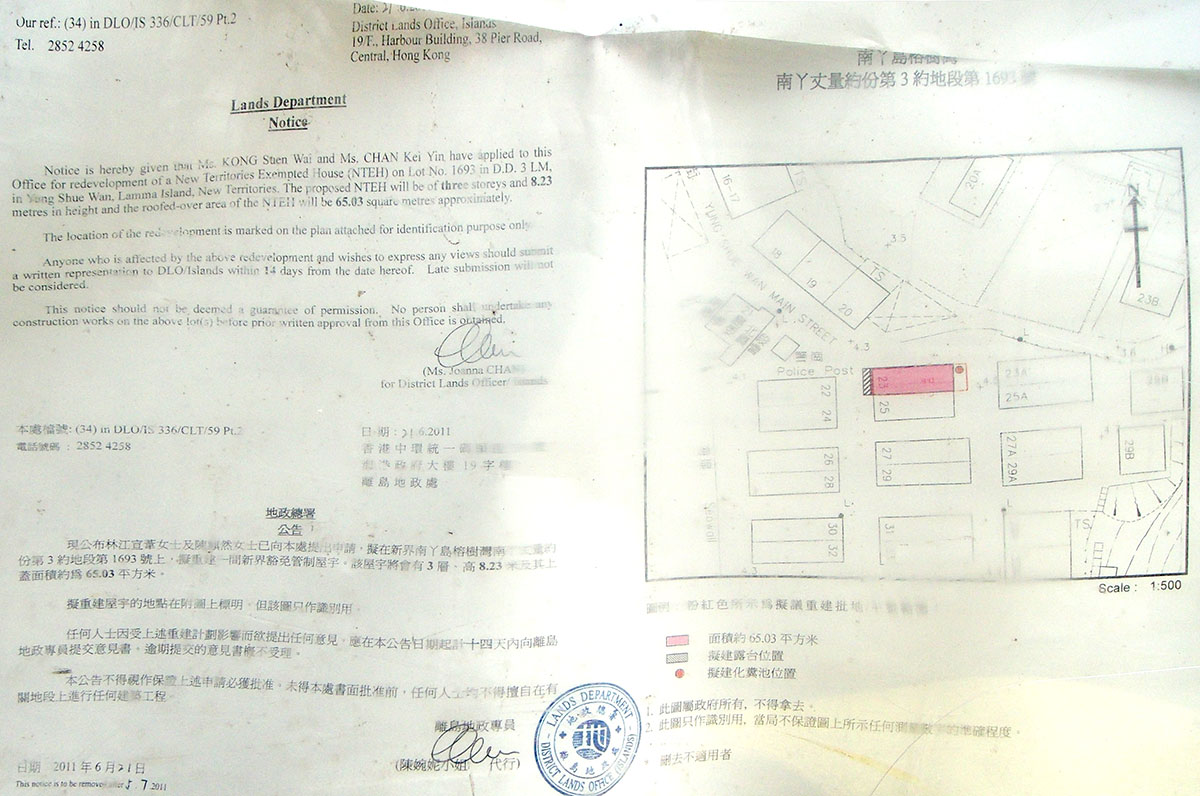
One more objection from a Diesel's regular, making some good points:
{L_QUOTE}:
Firstly, the current buildings located on this site are historical architectural examples, which offer the community a priceless heritage value. The building was previously believed to be a temple as well. On the Yung Shue Wan Main Street, it is the oldest standing structure and a landmark for the entire island and community.
Furthermore, as a building with distinct and rare architecture, only observed because of its location and unique history, it provides an invaluable tourist and historical value that must be cherished and preserved. As a testament to its worth, it is the subject of attention for many photographers, visitors to the island and it dwarves even the local Tin Hau temple in scale - and possibly even in age.
Additionally, its current use as a social gathering place fostering community togetherness is another compulsive factor why such heritage must not be destroyed senselessly.
There are plenty of open, available and more suitable spaces for ugly, uninteresting and meaningless residential village houses to be built. There is no point in demolishing a standing testament to history for those purposes.
plus one more objection for Mr Kebab's redevelopment:
{L_QUOTE}:
...worried that a full scale redevelopment will:
1. Create a huge amount of waste that may lead to further dumping on the island. We have already witnessed an increase in dumping on agricultural land on Lamma. Notably a recent redevelopment of a building on Main Street resulted in dumping on a lily pond and area where Romer's tree frogs, a protected species, had been sighted. While we alerted the relevant departments and presented papers to Legco, it seems that nothing can be done because of loopholes in the law. These incidences of dumping are causing a great deal of distress in our community and contributing to the general degradation of our living environment. What guarantees can be made that the proposed redevelopment of Lot no. 1693 in DD3 LM will not result in further dumping?
2. Create safety and congestion problems. The building in question is on a very busy part of Main Street. As such the building site will need to be managed with great care. Will the redevelopment require that the path be closed at certain times?
3. Possible conflict with a neighbouring HAD project. We understand that HAD is intending to renovate the well area that is adjacent to the building and put in benches. Any building work may damage this work. There should be co-ordination between the owner of the site and the HAD works team.
4. Loss of livelihood. The redevelopment of the building will not only cause loss of business for the existing tenants but also impact neighbouring businesses. Dust and noise problems are a major concern. Measures should be taken to mitigate these problems and the neighbouring restaurants and shops should be consulted. We have spoken to the next door shop today and they were unaware of the notice.
5. Visual impact. The building stands at the centre of the village. It is a natural meeting point and as such has a major visual impact. While the current state of the building is woeful, it is hoped that renovations could be undertaken that would make the building attractive and ensure that it is in keeping with the natural environment of which it is a part. Should the owner wish to discuss this further, Living Lamma has architects and designers among its membership who would be happy to contribute ideas. An attractive building would be an asset to the village and in turn provide the owner with more value.
We wonder if it is possible to renovate the building, rather than have a full-scale redevelopment?
If a redevelopment is necessary, can we ensure that the points raised above are addressed before permission is given for the work to be undertaken with written commitment from the owner on what measures will be taken to mitigate these problems.




 Login
 Register
 FAQ
 Search